

Still life by Nicolas Poliakoff
Nr. 2789 | 7.500,--€



Nicolas Poliakoff
(1899–1976)
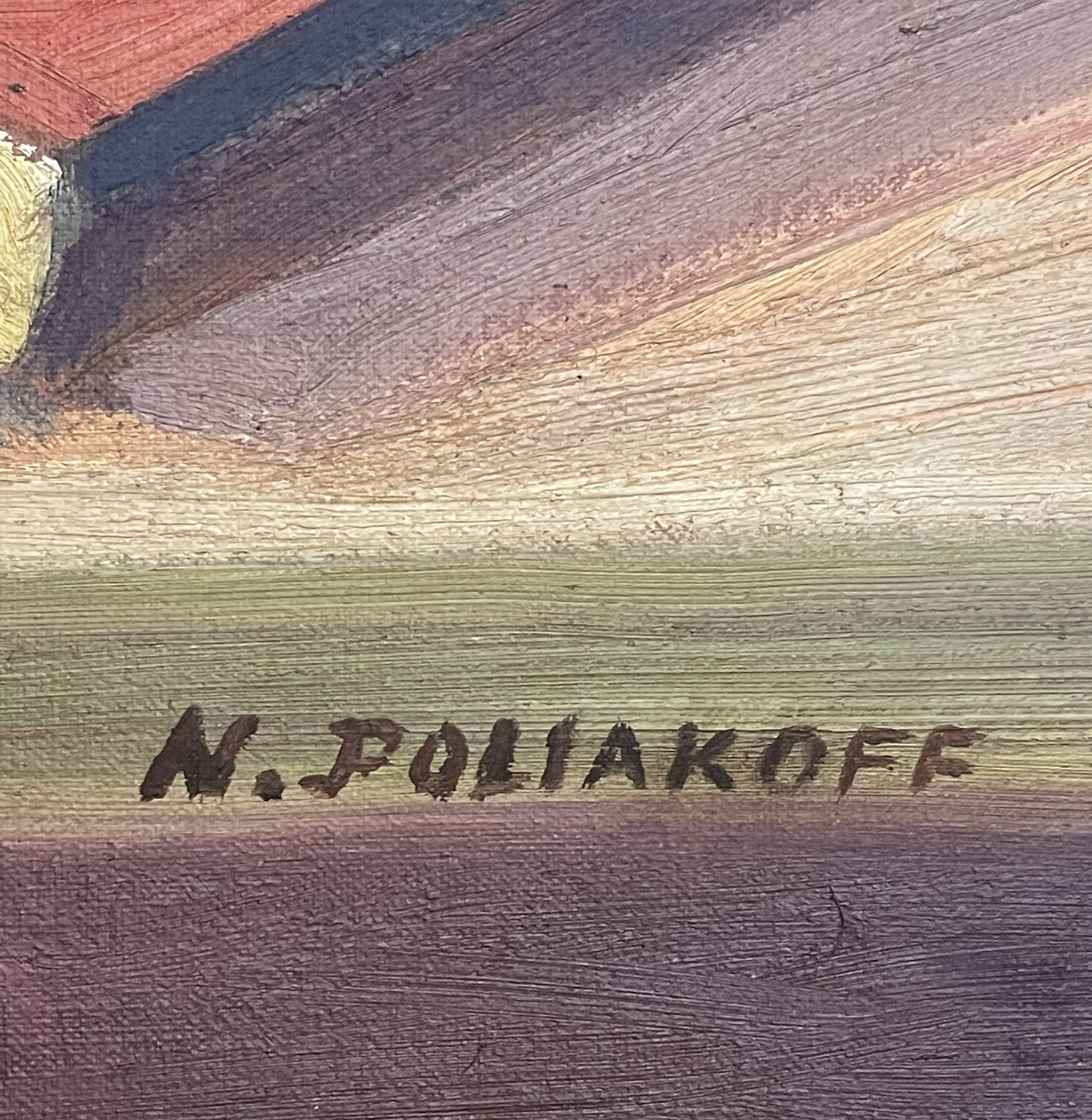
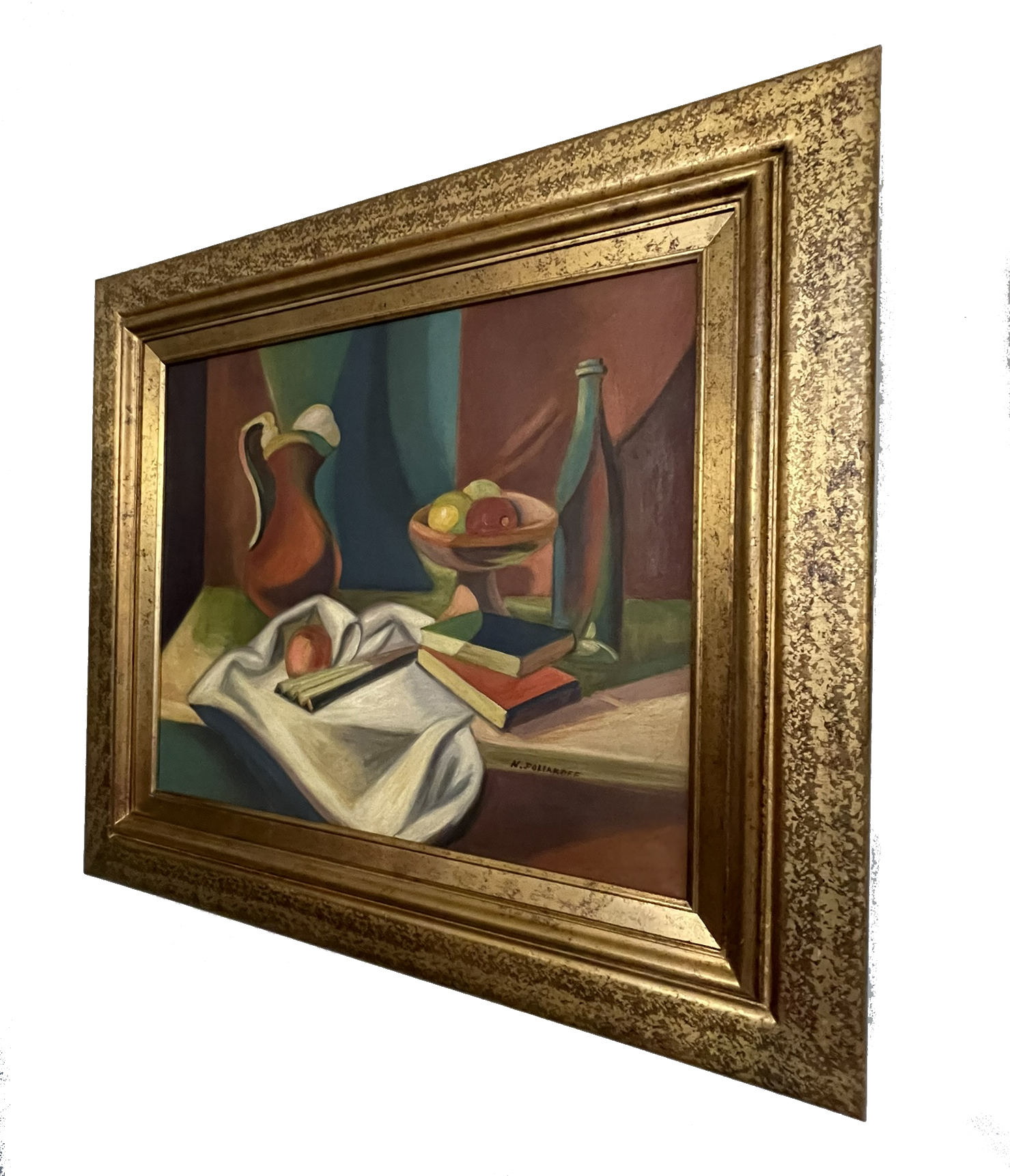
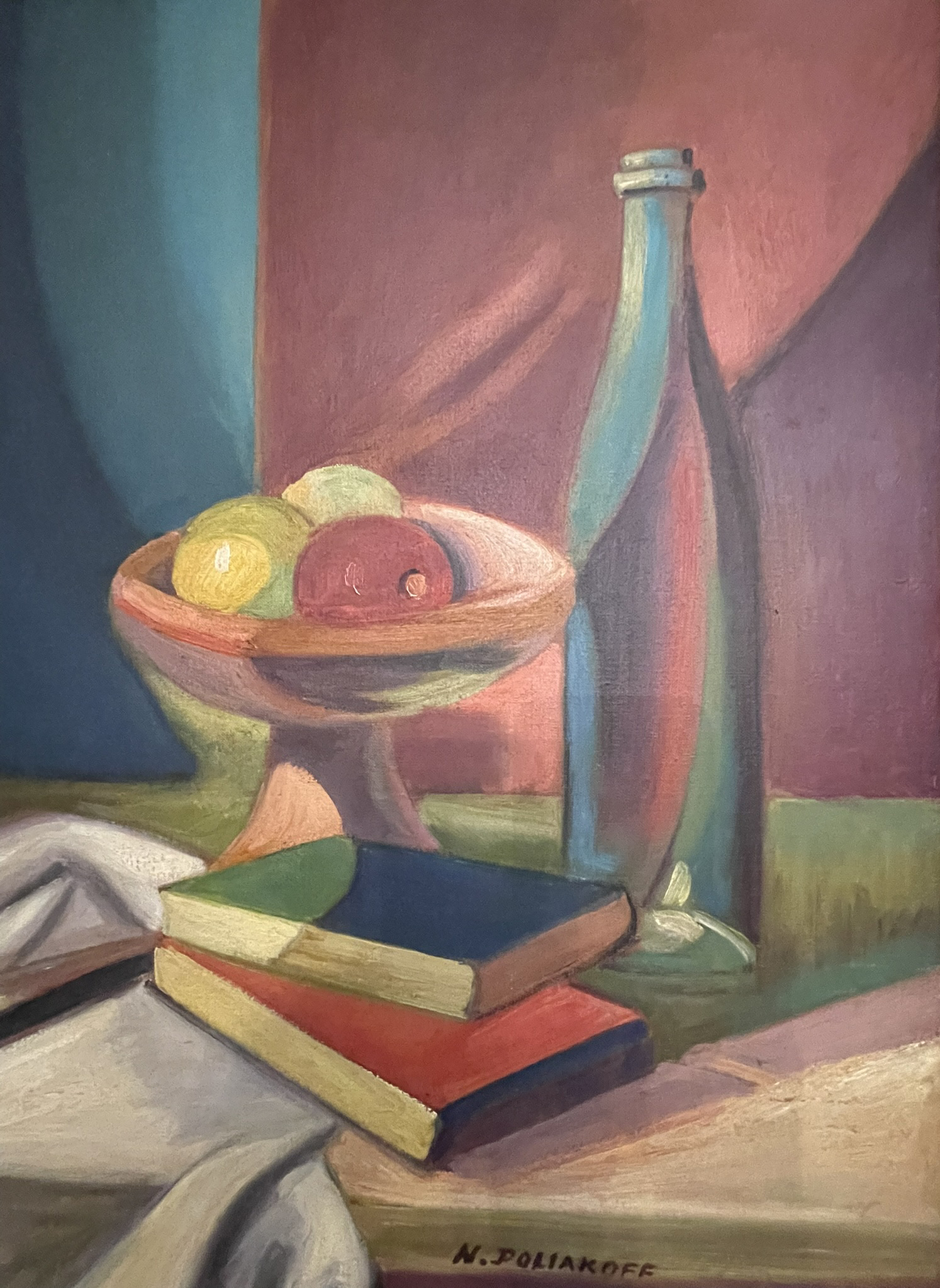
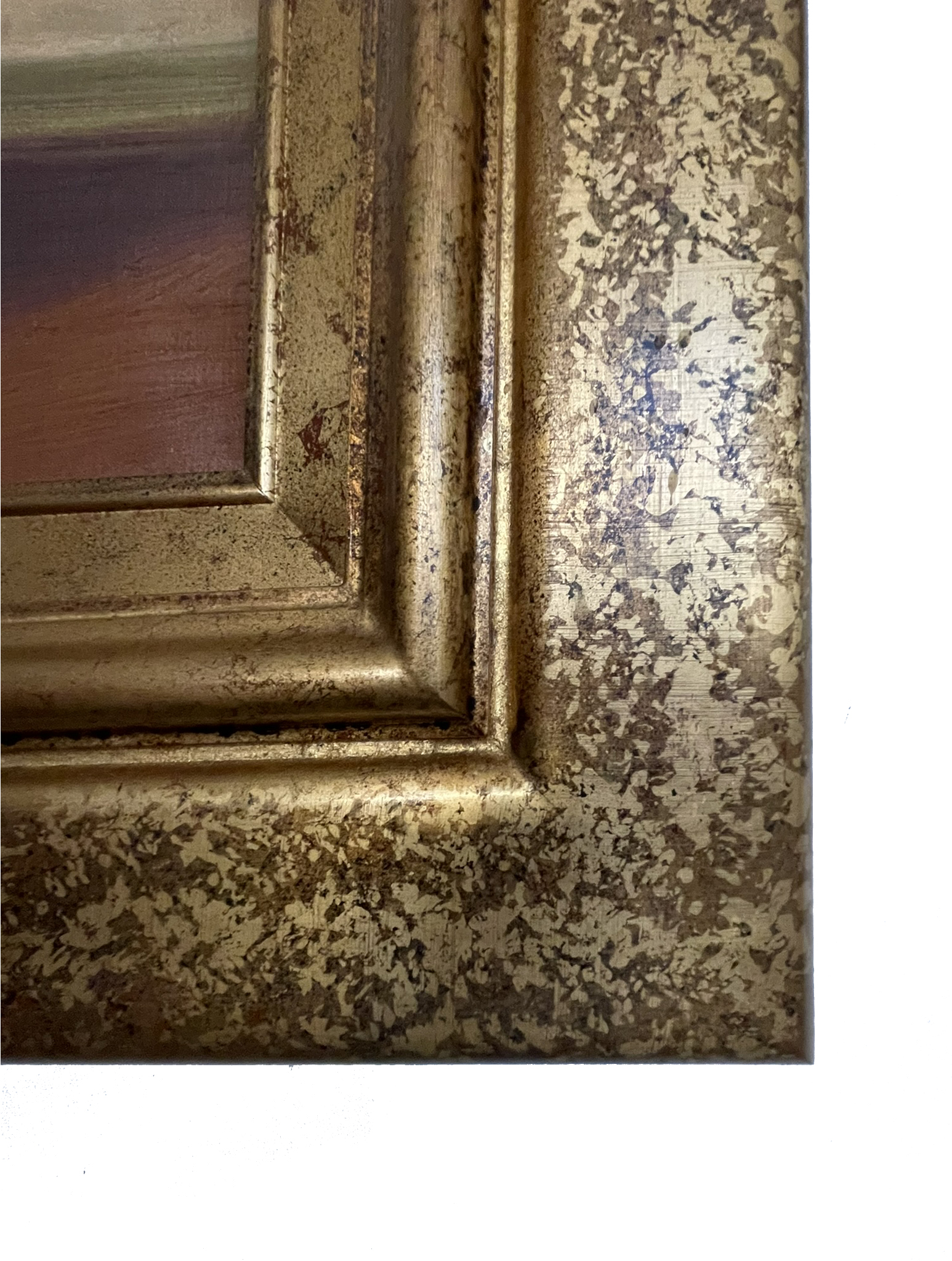
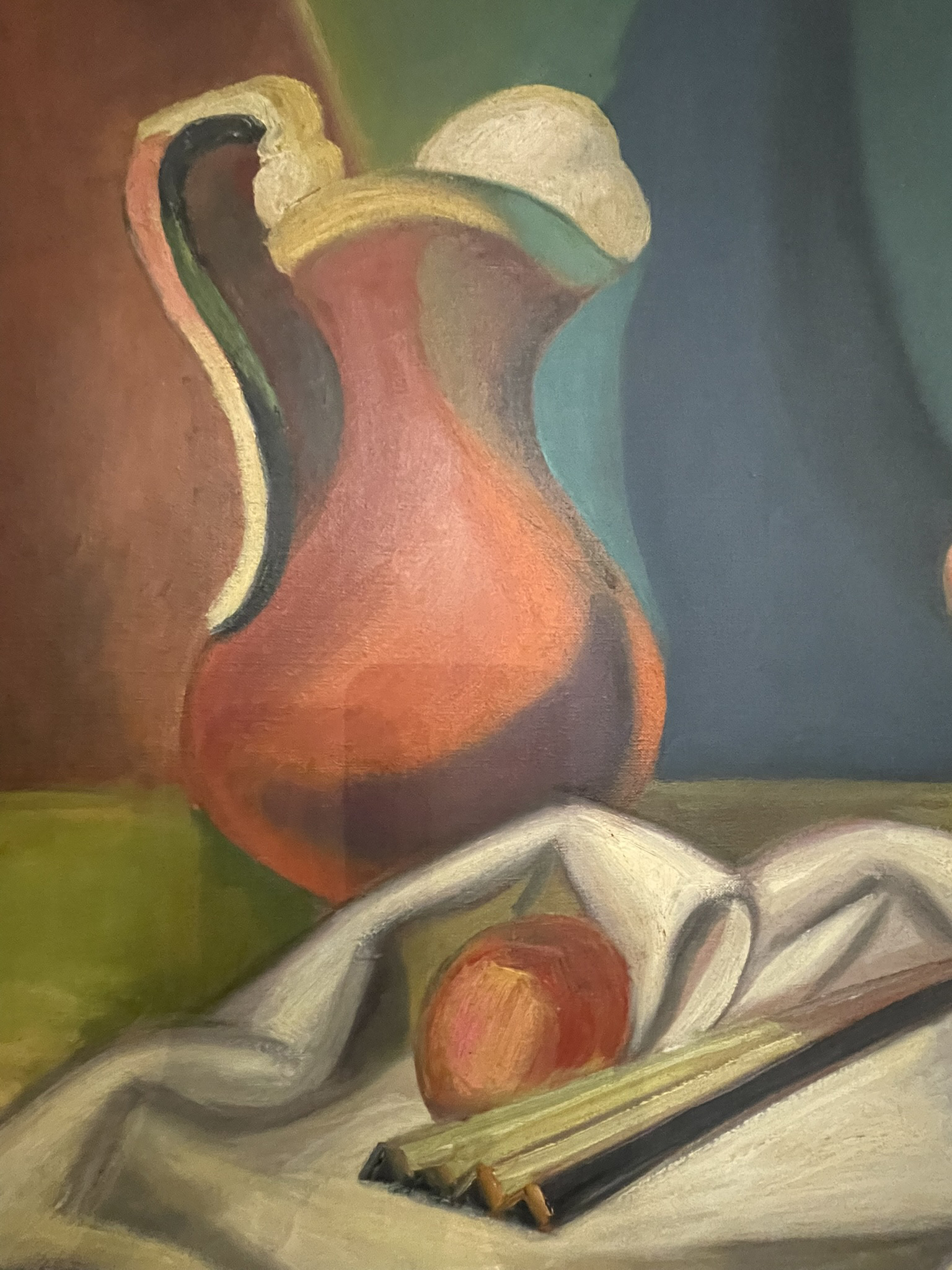
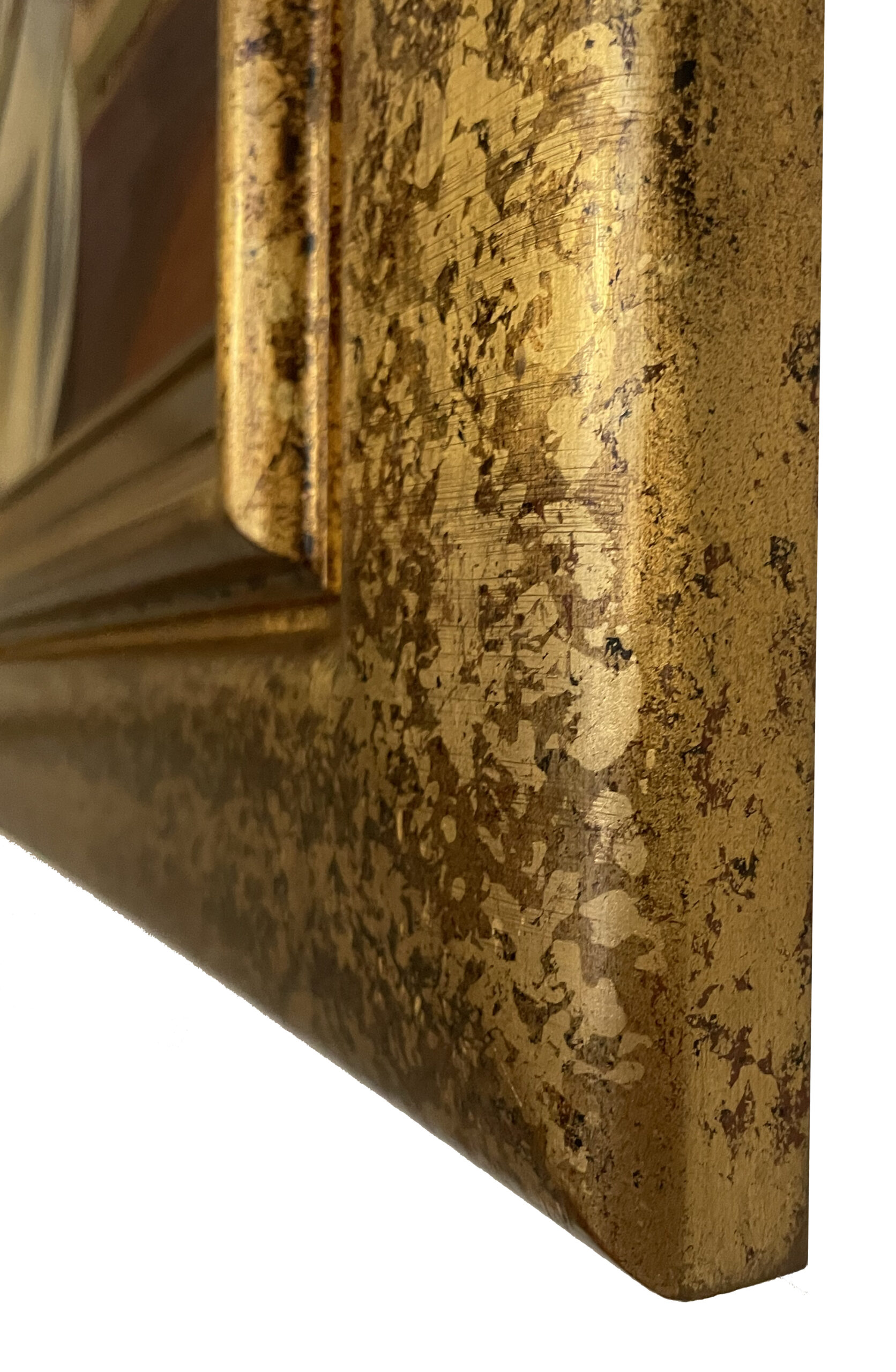
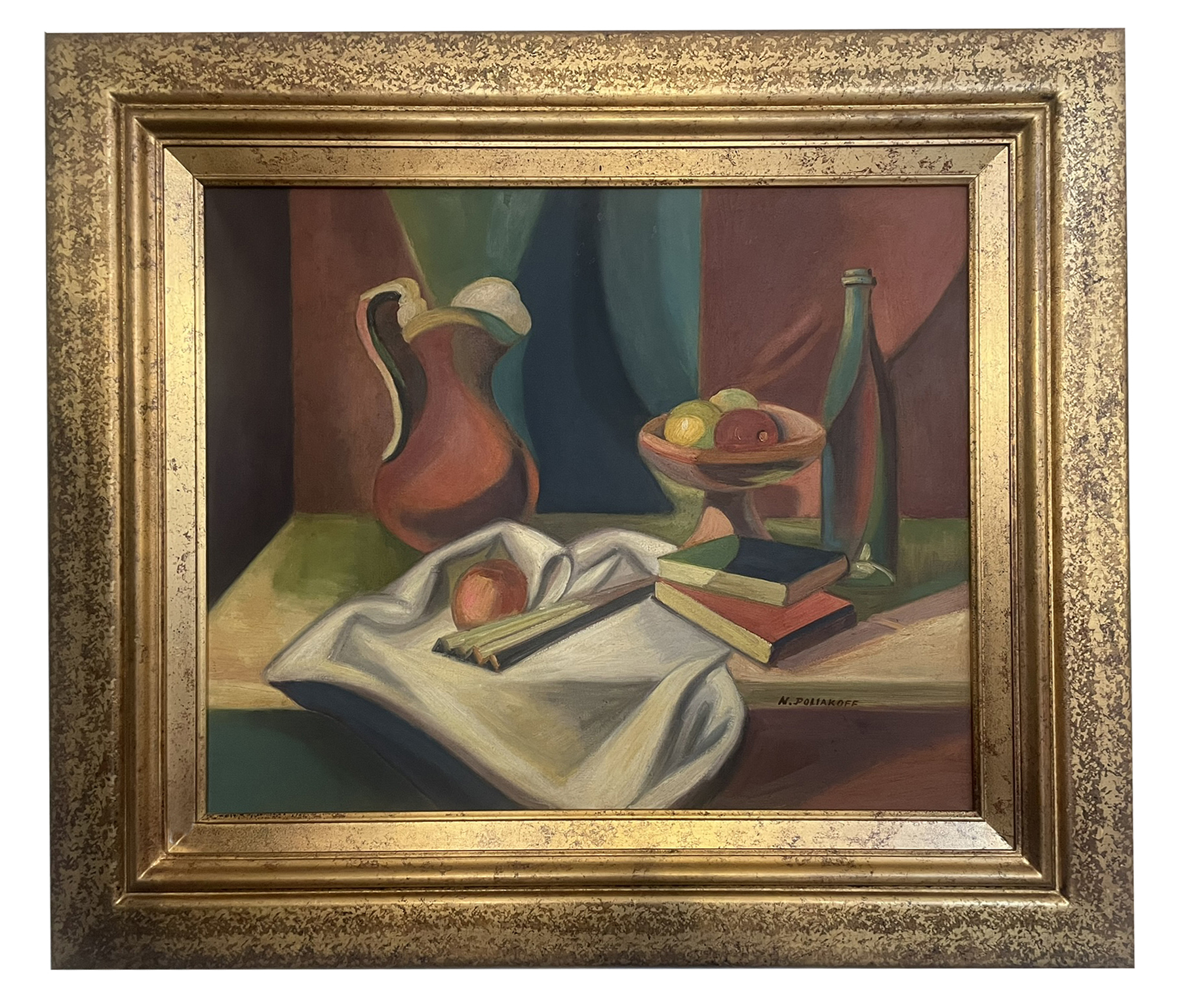
Still Life with Pitcher, Fruit Bowl, Bottle, and Books, oil on canvas, signed lower right
“N. Poliakoff.”
Provenance: Private Collection, Hesse
Formerly Hermann-Simsch Art Gallery, Frankfurt
Height: 101 cm | Width: 88 cm (framed)
Nicolas Poliakoff (1899–1976)
Still Life with Pitcher, Fruit Bowl, Bottle, and Books, oil on canvas, signed lower right “N. Poliakoff”.
In this still life, Nicolas Poliakoff condenses familiar studio objects into a constructively built pictorial order. The pitcher, bottle, and books are presented as geometric volumes. While the cloth and background drapery divide the space into flat zones of color, Poliakoff thus combines the tradition of the Parisian still life with a post-Cubist grammar.
Within this grammar, drawing, edge definition, and color planes create a balanced field of tension. The work is exemplary of Poliakoff’s position within the École de Paris. It is modern in form, yet consciously oriented toward a classical compositional discipline.
Short Biography
Nicolas Poliakoff (also: Poliakov/Poliakoff) belongs to the generation of the École de Paris. After 1925, Paris became an international center of modern art. He initially studied in Belgrade and arrived in Paris in 1925. There, he worked and taught in the circle of André Lhote. His work primarily explores still life, figure/nude, and portraiture.
It is characterized by a constructive, Cubist-influenced approach to form. Objects and bodies are constructed using planes, edges, and clearly contrasting color fields. Poliakoff thus represents a “classical modernism” that utilizes the Cubist method of composition. However, he does not dissolve the object itself.
Nicolas Poliakoff
Nicolas Poliakoff (Russian: Nikolai Georgievich Poliakov / Поляков; July 22, 1899 – July 1, 1976) belonged to the École de Paris. This was the internationally influenced generation of artists who chose Paris as their center of work and exhibitions during the interwar period. In contemporary art, he is primarily perceived as a Cubist-influenced painter of figures and still lifes.
He is considered less an avant-gardist in the radical sense, but rather a consistent representative of “classical modernism.” He maintains a balance between construction, drawing, and color fields.
Origin, Education, Arrival in Paris
Poliakoff was born in Ukraine; his birthplace is often given as Aleksandrovsk (historical name; today Zaporizhzhia/Zaporizhzhia). He received his initial artistic training at the École des Beaux-Arts in Belgrade (October 1921–July 1925). In October 1925, he moved to Paris, where he studied at the Académie André Lhote (18, rue d’Odessa).
The “Lhote School” as a defining constant in his life
Crucially, Poliakoff was not merely a student. From 1926, he served as a “massier” (organizational officer within the Academy) and became André Lhote’s assistant—until Lhote’s death in 1962. According to sources, he also taught there until 1965. This places Poliakoff within a tradition that understands Cubism less as the destruction of the object and more as a methodical pictorial architecture (construction based on axes, planes, and proportions).
Studio, Parisian Milieu, Louvre
From the 1930s onward, Poliakoff worked in the Montparnasse district. Until his death, he maintained a studio at 278 Boulevard Raspail. He was also a licensed copyist at the Louvre. This underscores the importance that disciplined drawing, the study of models, and tradition held in his self-conception.
Work and Style: Constructive Figuration
Depending on the period, Poliakoff’s works range from figure and nude to portrait, still life, and landscape. A constructed form is characteristic of his work. In this process, bodies and objects are transformed into angular volumes and clearly contrasting fields of color.
From an art historical perspective, this can be described as a “Cubist grammar.” It is not primarily collage or fragment, but rather a system of order. Space is organized through surface sections; contour and internal detail remain important, and color supports the construction (rather than dissolving it). This affinity with Lhote’s teaching tradition is stylistically quite plausible.
Exhibitions and Visibility in the Parisian Exhibition System
Poliakoff was a regular presence in the classic Parisian exhibition circuit: among others, at the Salon d’Automne (1926–1928) and for decades at the Salon des Artistes Indépendants (mentioned in sources until 1976). He also exhibited in galleries in Paris and participated in occasional shows abroad (e.g., Belgrade, Boston).
Relationship to Serge Poliakoff
In key artist biographies, Nicolas is listed as the brother of Serge Poliakoff (1900–1969). (Occasionally, differing information appears in auction descriptions; therefore, for reliable provenance information, one should preferably rely on reference data/archives.)
Death and Legacy
Poliakoff died in Paris in 1976. His oeuvre is encountered today primarily in the art market and at auctions. From an art historical perspective, he is particularly interesting as an intersection between the academic tradition (Lhote), the Salon system, and a “moderate” modernism that combines figuration and Cubist construction.
Another work from the collection is this Cubist still life with violin, signed “Gilberte Schmitt”.
Art Déco bei RSA Wiesbaden
You can find more Art Deco cabinets, Art Deco chests of drawers and Art Deco lamps in my shop in Wiesbaden. Regine Schmitz-Avila – your specialist for French Art Deco furniture and art objects from around 1930.
