


Cubist still life with violin, signed “Gilberte Schmitt”
Nr. 2786 | 4.500,--





“Cubist Still Life with Violin”
Artist: Gilberte Schmitt
born 1907 – died 2001
Oil on canvas
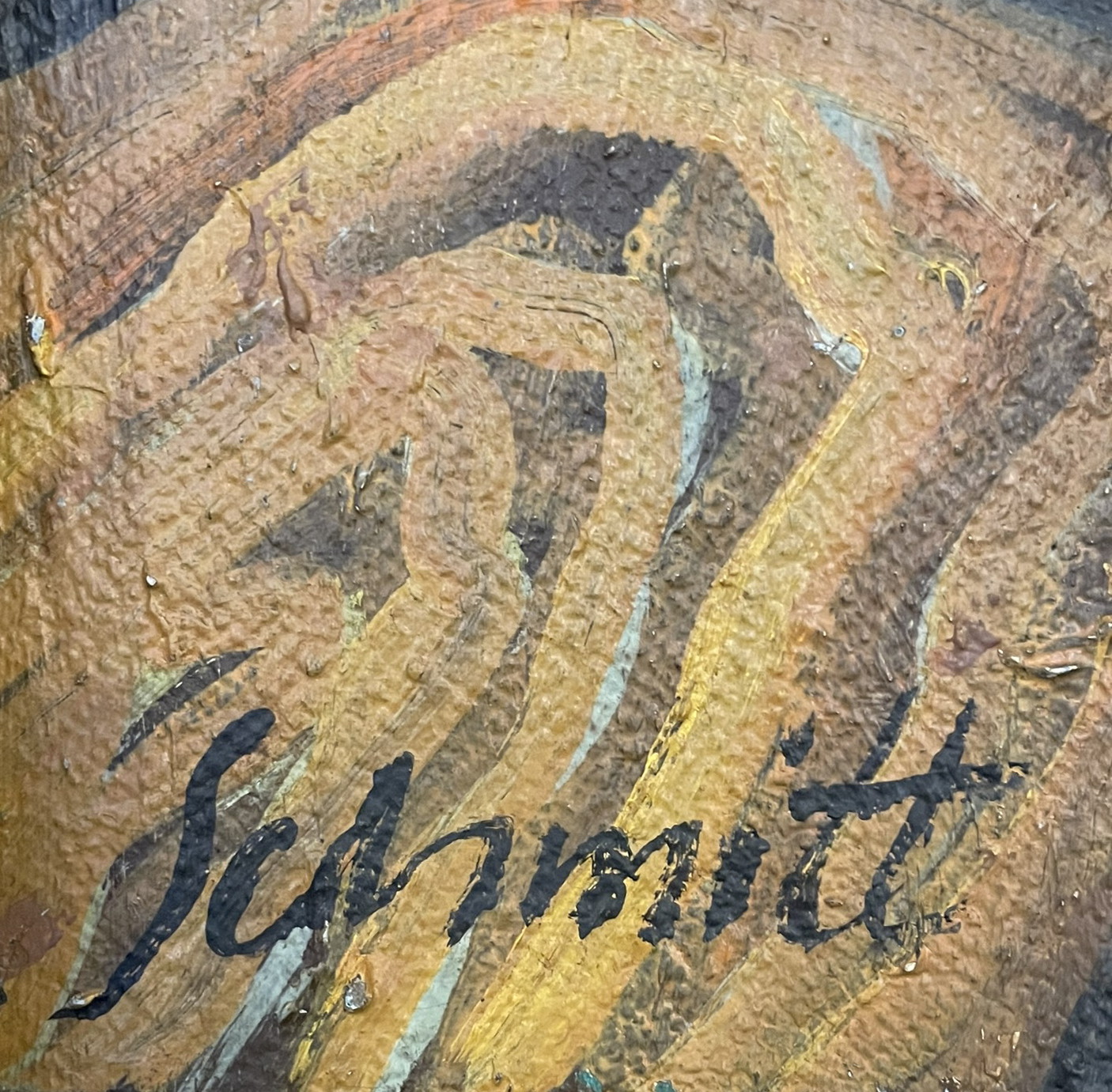
Signed lower left “Schmitt”
Height: 63 cm | Width: 55 cm
Cubist Still Life with Violin
Gilberte Schmitt (1907–2001)
Still Life with Violin
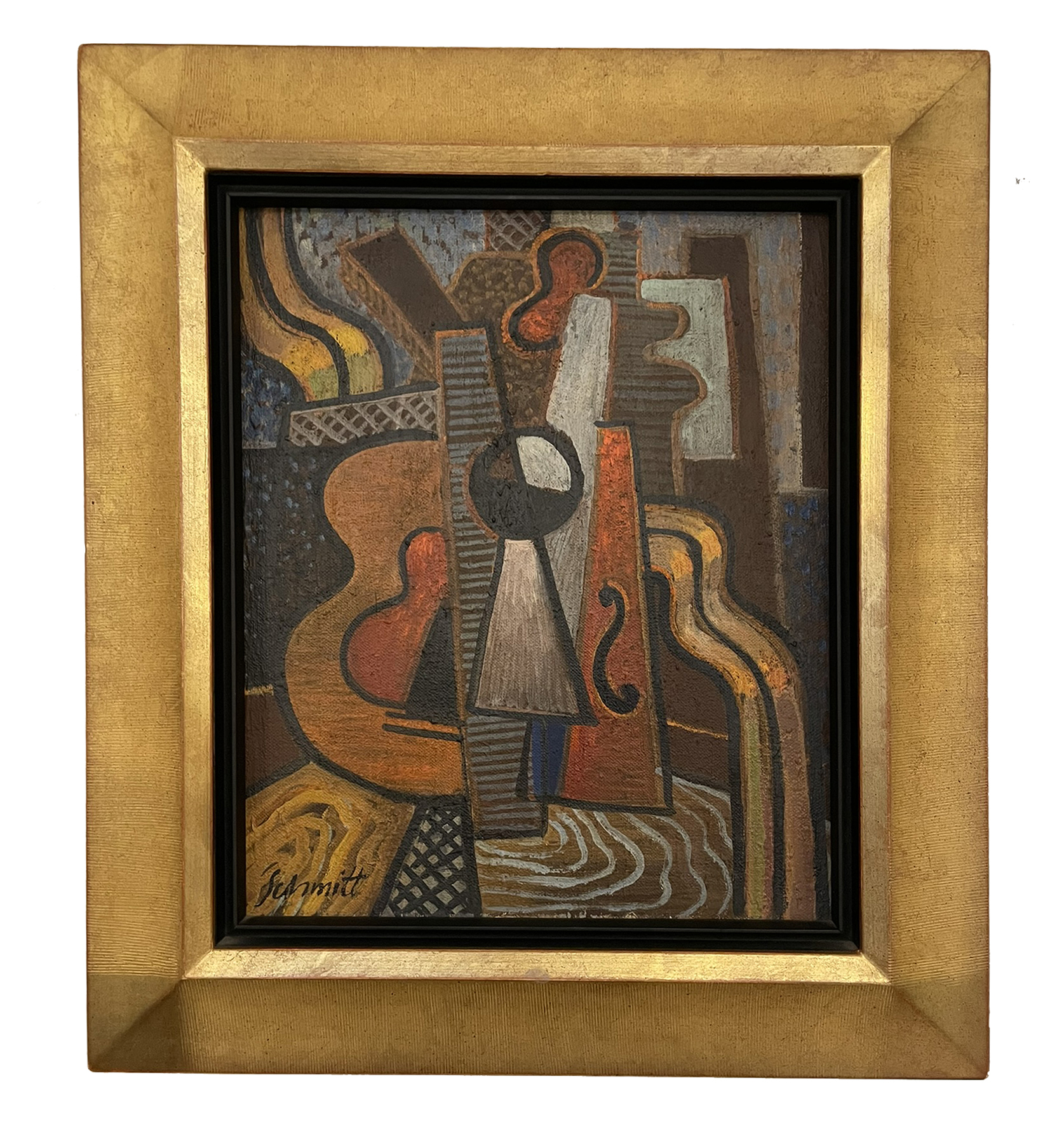
This work presents a Cubist-structured still life featuring the motif of a violin, constructed from geometrically divided planes and overlapping segments of form. The composition is vertically organized, combining angular volumes with curved contours. This creates a dynamic interplay between structure and rhythm.
The reduced, earthy palette of ochre, terracotta, and brown tones is accentuated by cool grays and blues; decorative stripes, grids, and wave motifs condense the surface and emphasize its musical character as a “visual score.” Overall, it is a typical example of synthetic Cubism or post-Cubist modernism. In this work, the instrument is not depicted naturalistically, but rather as a symbol and a formal concept.
This expressive oil painting on canvas by Gilberte Schmitt presents a modernist-cubist composition centered around the world of music. The rhythmically structured planes evoke the sounds of stringed instruments—such as guitar and cello. Abstracted sound forms create a captivating still life that oscillates between figuration and abstraction.
At the center is a vertical group of forms with contrasting light and dark areas (gray, black, white), which acts like a “timer,” structuring the picture plane. Around it, organic lines and flowing contours in warm ochre, terracotta, and rust tones sway. These are further punctuated by cool shades of blue and gray. Delicate patterns—grids, stripes, checkerboard, and wave motifs—lend the work depth and an almost textile-like surface.
Architectural and musical
The composition is simultaneously architectural and musical: forms are layered like stage scenery, lines resonate, and the eye is repeatedly drawn back to the center. It is a distinctive piece with a strong graphic presence. Therefore, it is ideally suited as an accent piece for modern interiors, collectors of classic modern art, and art-loving spaces.
Another work from this collection is by Cubist painting by Sigismund Kolos-Vary “Woman with Tulip”, 1936
Art Déco bei RSA Wiesbaden
You can find more Art Deco cabinets, Art Deco tables and Art Deco lamps in my shop in Wiesbaden. Regine Schmitz-Avila – your specialist for French Art Deco furniture and art objects from around 1930.
